Unions – An introduction
To most people, a Trade Union is an organisation of workers created to defend and improve its members’ conditions with respect to things like pay, pensions and benefits.
This is partially accurate, but definitely far from the whole story.
It leaves out the other side of trade unionism: the backroom deals, the cuts in pay and conditions presented as a “victory”, the strikes called off pending endless negotiations, labor party careerism, comfy salaries, the members told to break the strikes of other unions, the union activists disciplined and exploited by their own unions…
Time and again, union leaders – even left-wing ones – disappoint us. And just like with politicians, every time they do, there’s always another one telling us it’ll be better next time if we elect them. The problem, however, is deeper than having chosen the wrong person for the top-spot.
Today, most people’s understanding of unionism is very limited. For some, unions act as an organ for self-defense from employers, which is an activity necessarily separate from workers expressing their political will. For others, unions act as labour cartels, taking dues money from hard-working people to squander on political lobbying and the lavish lifestyles of the union’s top officials. Of course, there are interpretations of what unions are that lie everywhere in between. But all these views share the assumption that unions are inherently alien to the workers – something that operates above and over them.
Those who work for trade unions themselves will often say the same thing; “We’re not the union, the union is the workers! We can’t do anything if the workers don’t want to!” – but this ignores the tension within the organisational form itself.
It is thus taken for granted by most on both the Right and the Left that ‘The Union Question’ begins not with workers’ self-organization, but with a particular organisational form, i.e, a bureaucratic interest group servicing one subset of workers or another. What They conform to legally-sanctioned representative institutions that are run by professionals who specialise in “union” work.
Anarcho-syndicalists have a very different vision of what a union can be.
Since the earliest days of capitalism’s development, workers have organized to protect their interests from an increasingly powerful exploiting class. During the 18th century, workers’ organisation was often transient – sometimes to address a specific grievance, other times a violent rebellion against the exploitative social order. But by the late 19th century, permanent labour organisations had become prominent.
Along with repression, capitalists increasingly responded with insourced solutions to class war through increased employee propaganda, seeking to equate the sale of one’s labour power with a purpose and passion to save the world. Workers are trained to view their own productivity and efficiency with a sense of pride and as a means for achieving greater financial incentives. We see this in the retail sector with the emphasis on “Team” or department based profit sharing programs.
The Pledge
Though unionism can take on many forms, for anarchists it comes to life at the most basic level when two or more workers band together to struggle in their common interest. Here the base “concerted”, or collective aspect of the workers’ activity is foundational. In this scenario, workers themselves act together to address common concerns. No one acts in their stead. Unionism is here not merely passive enrolment into a representative labour institution, but a practice of solidarity and struggle carried out by real workers in real time. It is an at times unspoken pledge of solidarity amongst each other. A union with this as its content is a whole different kettle of fish than the aforementioned Trade-Union.
Now, two or more workers engaged in workplace struggle is not on its own necessarily building a union per se. Where an instance of self-activity could dissipate or pass, unionism for anarchists is the practice of consolidating workers into an organisation that acts to advance their interests on an ongoing basis –an ongoing dialogue.
In recent decades, trade-unionism has meant that representatives do the “protecting” in the form of negotiating with management on the workers’ behalf, thus “unions developed a life independent of their membership and began to operate over their heads”. Anarchists call this tendency the representative function of unions as we know them now, in contrast to the associational function of workers relating directly to each other without the mediation of an entrenched bureaucracy.
This distinction is useful as it demonstrates that unions can have diverging trajectories, leading to them playing very different roles in society. While many on the left take the representational function of unions for granted (understandably portraying unions as backwards institutions who have a stake in maintaining capitalism), clearly there have also been many workers’ organisations throughout the history of capitalism that have retained their associational function and represented a genuine threat to capital. Whether we call it a council, a union, or anything else doesn’t change the fact that it is possible to create and maintain “an organisation of workers formed to protect the interests of its members” – and that such a formation can retain its autonomy from the State and its allied institutions, can win improved conditions for workers under capitalism, and, further, can facilitate the development of a revolutionary politics from the base upwards amongst the people. The fact that such formations must come up against limitations under this system does not render them irrelevant, ineffective, or “infantile”.
Bureaucracy
Trade Unions of any reasonable size have a paid staff, and are organised like a company. You have six-figure salary earning executives, appointed middle-managers enforcing decisions from the top and a career ladder into social-democratic political parties, think-tanks, government departments. Through BSN we’ve met people who work for trade unions that ‘needed a union’ because their conditions were being attacked!
In the workplace unions are run day-to-day by workers who volunteer to be representatives, and often suffer personal costs in terms of victimisation for their troubles. However, union members and their lay reps in the workplace can also come into conflict with the union’s paid bureaucracy.
This is because the rank and file – the base of the union – have different interests to the people who work for and run the union. Union leaders have to put the needs of the union as a legal entity above those of the union as a group of workers fighting for their own interests. This is because their jobs and political positions are dependent on this legal entity continuing to exist. It’s a perpetual cycle of inaction and disempowerment – it gets to the stage where supporting any action which could get the union in trouble is just not on the cards for union leaders. Is it really any wonder that the majority of people ask for a lawyer’s number instead of the union’s?
Lay rep or shop steward posts – often taken by the most militant workers – can be complicated. Unlike full-timers, they still work on the shop floor and are paid like those they work with. If bosses cut pay, their pay is cut too. And as a workplace militant, they can be victimised by their bosses for their role. However, they must also balance between shop floor interests and the union bureaucracy’s interests. For example, a union rep may be furious that her union is recommending workers accept a pay cut, but she will still have to argue for workers not to leave the union. If they put workers’ interests ahead of the bureaucracy’s they can find themselves under attack not only from their bosses, but also their trade-union.
Even at regional and local levels, full-timers don’t share the interests of their members. This isn’t to do with their ideas or intentions (lots of full-timers are ex-workplace militants who want to help workers organise beyond their own workplaces), it’s about their material interests. A win for a worker is more money, longer breaks, better benefits. A win for a full-timer is often a spot at the negotiating table with management.
In this way open conflict between employers and workers could be minimised, and the actual say workers would have could be drastically limited by creating complex legal structures through which our official “representatives” would speak on our behalf. And similarly the way in which we can have our say could also be regulated within a legal framework overseen by the state.
This process has taken place in different ways in different countries and different stages in history, but the net result is similar. Across much of the West we can join unions freely but the actions we can take to defend ourselves from employers are limited by the web of industrial relations laws. Big barriers are placed in the way of taking effective strike action, in particular by banning any action which is not directly related to particular union members’ terms and conditions and any kind of solidarity action. The unions have to enforce these anti-worker laws on their own members, as if they did not they would suffer financial penalties and asset seizure – and therefore cease to exist.
Furthermore, once unions accept the capitalist economy and their place in it, their institutional interests become bound to the national economy, since the performance of the national economy effects the unions’ prospects for collective bargaining. Instead of ‘union’ values like solidarity, dignity and anti-capitalism, they want healthy capitalism in their country to provide jobs so they can continue to play their role. It’s not uncommon therefore for trade unions to help hold down wages to help the national economy, as the British Trades Union Congress (TUC) did in the 1970s, or even assist their national governments in mobilising for war efforts, as unions did across Europe in World War I, or as the militant US United Auto Workers (UAW) did in World War II, signing a no strike pledge.
Selling peace in the workplace
One thing which many radical and left-wing union members often argue for is ‘reclaiming the unions’ or, sometimes, building new trade-unions without bureaucrats at all. The thing is, unions don’t function how they do because of bureaucrats; it’s that bureaucrats are created by how unions function (or want to function) in the workplace.
The trade-union’s role is a tricky one: in the end, they have to sell themselves twice, to two groups of people with opposing interests (i.e. bosses and workers).
To sell themselves to us, they have to show that there are benefits to union membership. This sometimes means they can help us take action to force management to maintain or improve our conditions, especially if they are trying to gain recognition in a workplace for the first time.
Through getting us to join, they show management that they are the main representative of the workforce. But equally, they also have to show that they are responsible negotiating partners.
Management need to know that once an agreement is reached, the union can and will get their members back to work. Otherwise, why would management do any deals with a negotiating partner that can’t honour the agreements it negotiates?
It is from this desire to be a recognised negotiating partner that unions end up acting against their own members. It shows them up in front of management as not being able to control their members. This is why in the UK in 2011 you get a Unite union negotiator calling a rank and file electricians’ group “cancerous” just as in 1947 a miners’ union official called for legal action against wildcat striking miners “even if there are 50,000 or 100,000 of them”. Similarly, at highpoints in the US union movement in the 1940s and 1970s, the UAW got its own members disciplined and fired for striking unofficially.
So when unions ‘sell us out’ it’s not just them ‘not doing their job properly’. They might do one side (ours) badly, but they’re doing the other side really well. After all, they need to be able to control struggles in order to represent them. And this is why the efforts of the so-called “revolutionary left” over the past 100 years to “radicalise” the unions by electing the right officials and passing the right motions have ended up in a dead-end. Indeed, rather than radicalising the unions, the union structures have more often de-radicalised the revolutionaries (similar to NGO’s and activism!).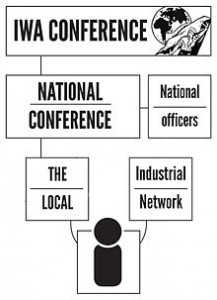
The only unions which have resisted this have been those that intentionally take a political-economic focus, and have specifically refused to take a disempowering representative role, like the historical IWW in the USA, FORA in Argentina and the modern day CNT in Spain. This refusal has cost them in reduced membership numbers, state repression, or both.
Anarcho-syndicalist organisations like these aim to promote solidarity in our movements, workplaces, neighbourhoods and beyond, encouraging movements to organise independently of government, bosses and bureaucrats to fight for our own interests as a class. Instead of our movements being based on top-down representatives, often this has taken the of a system of decentralised councils made up of recallable delegates from workplaces and communities. Examples of self-management like this point the way towards revolutionary anti-capitalism and the goal of a stateless, classless society.
EXAMPLE:
The recent struggle in and around the shipyards of Puerto Real, Spain, in both workplace and community, against threatened closure witnessed the anarcho-syndicalist union CNT playing both a prominent and decisive role.
The CNT’s involvement meant that the methods of organising and the forms of action taken departed from those common to reformist unions — with dramatic consequences.
When the PSOE government (socialist in name, but Thatcherite in practice, announced a programme of ‘rationalisation’ at the Puerto Real shipyards, the workforce came out on strike. The CNT was at the forefront in spreading the action to the surrounding population. Not only was the government defeated, but a number of pay and condition improvements were secured.
In this not only did the great determination and ingenuity on the part of the workers bring results, but that of the communities too. Mass assemblies both in the yards and surrounding localities involved workers, their families, neighbours and all supporters. Initiating and maintaining entire communities’ involvement in mass assemblies alone was fine achievement.
By all accounts the work of the CNT in and around Puerto Real established direct democracy as an inherent part of local political culture and resistance – people deciding for themselves, rejecting control by unaccountable politicians, union officials or ‘experts’, ensuring control remains in the workplace and locality. Not imposed unchallenged from above, be it by boards of directors or government, local or national.
“A century of contractualism has established no-strike clauses, management rights clauses and disempowering grievance procedures as the norms. I would argue that after the point in which it is obvious the union has won or is going to win, these are the most important issues for the employer, exceeding wages and benefits. To exclude these things in a contract would take serious organization within the workplace. If you do have the capacity to impose these sorts of demands, which are expected minimum norms for contracts, then why have a contract at all?”
Most unions take the easier road, helping to ensure peace, at our expense, in the workplace. They kick our problems into the long grass of grievance procedures, casework forms and backroom negotiations, divide us by trade and adopt NGO-style campaigning over workplace & political organising. And employers love it. As a manager at a multinational in South Africa once said when asked why his company had recognised the workers’ union: “Have you ever tried to negotiate with a football field full of militant angry workers?”
Fit for purpose?
Since the 1980s, we’ve seen huge attacks on humanity’s living conditions and drastic changes to the job market. Casual, temporary and agency work have become increasingly common, with workers changing jobs regularly. In the West, many of the traditional industries of the trade union movement have closed down and been replaced by those historically less organised like retail, hospitality and the service sector.
This new reality undermines traditional trade unionism as building union branches with a stable membership becomes much more difficult. However, rather than trying to keep members by helping militants organise in the workplace, the solution for the unions has been in mergers and in offering supermarket discount cards and cheap insurance as perks of membership.
Equally, the international nature of the job market has further undermined the official unions. Workers can be employed in one country while working in another and companies themselves can move factories and offices to where labour is cheaper.
For instance, in 2011, Fiat workers in Italy were encouraged by their unions to accept worsened contracts under threat of having the work moved to Poland. Meanwhile, Polish workers themselves were struggling against Fiat. However, in neither country did the unions try to forge international links between workers.
Breaking the rules together
Whereas the trade-union’s representative function makes dealing with the trade union bureaucracy extremely slow and draining for those in them, these changes to the job market have made them more or less irrelevant for many workers outside of them.
When industrial disputes come up, non-union workers feel they can’t do much to support them while even those striking may feel they are just going through the ritual of official strike action: management put forward a terrible offer, the union is ‘outraged’ and calls a one-day strike (maybe a few), negotiations restart and strikes are called off, management come back with a very slightly less terrible deal and union bosses declare victory and recommend it to their members. Even this is considered ‘radical’ by most trade-union standards.
However, it does not always have to work like this. The important thing – whether we are members of a union or not – is that we go beyond the limits set by the official unions and restrictive labour laws. Instead of voting for different representatives or passing motions in stale union branch meetings, we need to organise together with our co-workers at the base, to break their rules and stick to our own:
- Workplace meetings need to be open to all workers, regardless of what job they do, which union they’re in (if any) or what kind of contract they’re on.
- We need to respect each others’ picket lines. Too often workers go on strike only to see their colleagues in other unions go into work. This makes all of our strikes weaker and only by sticking together can we shut down our workplaces and beat our bosses. For instance Shell tanker drivers won above inflation pay increases in 2008 when drivers from other companies refused to cross their picket lines.
- We rely on direct action and collective strength to get what we want, whether covered by industrial relations law or not. In 2008, bin workers in Brighton (UK) fought back against management bullying, winning after barely two days of wildcat action. Another wildcat later that year confirmed their willingness to strike, with or without official union backing. So in 2009 when management tried to cut their pay by up to $8000 (per year, per worker), they forced management to back down just two days into a week-long official strike.
- Strikes need to be spread. Often issues don’t just affect one workplace but whole industries and even across industries. We need to make links between our workplaces so we can come out to support each other. In 2009, when oil company Total tried to sack 51 workers, everyone walked out in support. Total responded by sacking over 600 workers for taking unofficial action. However, strikes spread across the energy industry and in just over a fortnight everyone got their jobs back.
- Solidarity needs to be as international as our employers. Instead of blaming immigrants taking jobs or undercutting wages, or foreign workers when factories are moved overseas, we need to support migrant workers and workers in other countries struggling to improve their pay and conditions. This will not only benefit them directly but will also mean that employers will no longer be able to use them to undercut wages of native workers either.
These are not new ideas. These are things which workers – both in formal unions and out – have done throughout history and, in doing so, have often come into conflict not just with their bosses but also their union bureaucracy.
Conclusion
We often see unions as an organisational framework that gives us strength. And certainly, this is partially true. What we don’t always acknowledge (or at least don’t act upon) is that the strength a union gives us is actually just our own strength channelled through – and therefore limited by – the modern Trade Union structure.
It is only by acknowledging this and taking struggle into our own hands – by ignoring union divides and not crossing each others’ picket lines, by not waiting for our union before taking action, by taking unsanctioned action such as occupations, go slows, economic blockades and sabotage – that we can actually use our strength and start to win. Solidarity, selfmanagement & Self-organisation!
SEE MORE:
Anarchist work groups & 1-3 organising
BSN Workplace & Community organising guide
Squatter’s handbook
Anarcho-syndicalism in Puerto-Real
Anarchism in Action [Film]
Revolt in Patagonia [Film]